
Showing posts with label Found. Show all posts
Showing posts with label Found. Show all posts
Wednesday, 23 August 2017
Shop Window
The following is a scan of a postcard that I found in my clutter. (You can see the holes from where it has been pinned to my old office wall.) I don't know for sure, when or where I bought it but it continues to fascinate. Very few shop windows, if any, can be said to do that - and certainly not in quite this way. It is entitled 'Naturalist, rue de l'Ecole de Medecine' and was taken in 1926 by the French photographer Eugène Atget (1857-1927). (It can also be seen - in better quality - online at Wikimedia Commons and The J. Paul Getty Museum.)


Tuesday, 11 October 2016
Pascal's Pensées - 2
Following on from my first selection from Pascal's Pensées:
Selection 2
194. ... Let them at least learn what is the religion they attack, before attacking it. If this religion boasted of having a clear view of God, and of possessing it open and unveiled, it would be attacking it to say that we see nothing in the world which shows it with this clearness. But since, on the contrary, it says that men are in darkness and estranged from God, that He has hidden Himself from their knowledge, that this is in fact the name which He gives Himself in the Scriptures, Deus absconditus; [Is. 45. 15. "Thou art a God that hidest thyself."] and finally, if it endeavours equally to establish these two things: that God has set up in the Church visible signs to make Himself known to those who should seek Him sincerely, and that He has nevertheless so disguised them that He will only be perceived by those who seek Him with all their heart; what advantage can they obtain, when, in the negligence with which they make profession of being in search of the truth, they cry out that nothing reveals it to them; and since that darkness in which they are, and with which they upbraid the Church, establishes only one of the things which she affirms, without touching the other, and, very far from destroying, proves her doctrine?
In order to attack it, they should have protested that they had made every effort to seek Him everywhere, and even in that which the Church proposes for their instruction, but without satisfaction. If they talked in this manner, they would in truth be attacking one of her pretensions. But I hope here to show that no reasonable person can speak thus, and I venture even to say that no one has ever done so. We know well enough how those who are of this mind behave. They believe they have made great efforts for their instruction when they have spent a few hours in reading some book of Scripture and have questioned some priests on the truths of the faith. After that, they boast of having made vain search in books and among men. But, verily, I will tell them what I have often said, that this negligence is insufferable. We are not here concerned with the trifling interests of some stranger, that we should treat it in this fashion; the matter concerns ourselves and our all.
The immortality of the soul is a matter which is of so great consequence to us and which touches us so profoundly that we must have lost all feeling to be indifferent as to knowing what it is. All our actions and thoughts must take such different courses, according as there are or are not eternal joys to hope for, that it is impossible to take one step with sense and judgment unless we regulate our course by our view of this point which ought to be our ultimate end.
Thus our first interest and our first duty is to enlighten ourselves on this subject, whereon depends all our conduct. Therefore among those who do not believe, I make a vast difference between those who strive with all their power to inform themselves and those who live without troubling or thinking about it.
I can have only compassion for those who sincerely bewail their doubt, who regard it as the greatest of misfortunes, and who, sparing no effort to escape it, make of this inquiry their principal and most serious occupation.
But as for those who pass their life without thinking of this ultimate end of life, and who, for this sole reason that they do not find within themselves the lights which convince them of it, neglect to seek them elsewhere, and to examine thoroughly whether this opinion is one of those which people receive with credulous simplicity, or one of those which, although obscure in themselves, have nevertheless a solid and immovable foundation, I look upon them in a manner quite different.
This carelessness in a matter which concerns themselves, their eternity, their all, moves me more to anger than pity; it astonishes and shocks me; it is to me monstrous. I do not say this out of the pious zeal of a spiritual devotion. I expect, on the contrary, that we ought to have this feeling from principles of human interest and self-love; for this we need only see what the least enlightened persons see.
We do not require great education of the mind to understand that here is no real and lasting satisfaction; that our pleasures are only vanity; that our evils are infinite; and, lastly, that death, which threatens us every moment, must infallibly place us within a few years under the dreadful necessity of being for ever either annihilated or unhappy.
There is nothing more real than this, nothing more terrible. Be we as heroic as we like, that is the end which awaits the world. Let us reflect on this and then say whether it is not beyond doubt that there is no good in this life but in the hope of another; that we are happy only in proportion as we draw near it; and that, as there are no more woes for those who have complete assurance of eternity, so there is no more happiness for those who have no insight into it.
Surely then it is a great evil thus to be in doubt, but it is at least an indispensable duty to seek when we are in such doubt; and thus the doubter who does not seek is altogether completely unhappy and completely wrong. And if besides this he is easy and content, professes to be so, and indeed boasts of it; if it is this state itself which is the subject of his joy and vanity, I have no words to describe so silly a creature.
How can people hold these opinions? What joy can we find in the expectation of nothing but hopeless misery? What reason for boasting that we are in impenetrable darkness? And how can it happen that the following argument occurs to a reasonable man?
"I know not who put me into the world, nor what the world is, nor what I myself am. I am in terrible ignorance of everything. I know not what my body is, nor my senses, nor my soul, not even that part of me which thinks what I say, which reflects on all and on itself, and knows itself no more than the rest. I see those frightful spaces of the universe which surround me, and I find myself tied to one corner of this vast expanse, without knowing why I am put in this place rather than in another, nor why the short time which is given me to live is assigned to me at this point rather than at another of the whole eternity which was before me or which shall come after me. I see nothing but infinites on all sides, which surround me as an atom and as a shadow which endures only for an instant and returns no more. All I know is that I must soon die, but what I know least is this very death which I cannot escape.
"As I know not whence I come, so I know not whither I go. I know only that, in leaving this world, I fall for ever either into annihilation or into the hands of an angry God, without knowing to which of these two states I shall be for ever assigned. Such is my state, full of weakness and uncertainty. And from all this I conclude that I ought to spend all the days of my life without caring to inquire into what must happen to me. Perhaps I might find some solution to my doubts, but I will not take the trouble, nor take a step to seek it; and after treating with scorn those who are concerned with this care, I will go without foresight and without fear to try the great event, and let myself be led carelessly to death, uncertain of the eternity of my future state."
Who would desire to have for a friend a man who talks in this fashion? Who would choose him out from others to tell him of his affairs? Who would have recourse to him in affliction? And indeed to what use in life could one put him?
In truth, it is the glory of religion to have for enemies men so unreasonable; and their opposition to it is so little dangerous that it serves, on the contrary, to establish its truths. For the Christian faith goes mainly to establish these two facts: the corruption of nature, and redemption by Jesus Christ. Now I contend that, if these men do not serve to prove the truth of the redemption by the holiness of their behaviour, they at least serve admirably to show the corruption of nature by sentiments so unnatural.
Nothing is so important to man as his own state, nothing is so formidable to him as eternity; and thus it is not natural that there should be men indifferent to the loss of their existence, and to the perils of everlasting suffering. They are quite different with regard to all other things. They are afraid of mere trifles; they foresee them; they feel them. And this same man who spends so many days and nights in rage and despair for the loss of office, or for some imaginary insult to his honour, is the very one who knows without anxiety and without emotion that he will lose all by death. It is a monstrous thing to see in the same heart and at the same time this sensibility to trifles and this strange insensibility to the greatest objects. It is an incomprehensible enchantment, and a supernatural slumber, which indicates as its cause an all-powerful force.
There must be a strange confusion in the nature of man, that he should boast of being in that state in which it seems incredible that a single individual should be. However, experience has shown me so great a number of such persons that the fact would be surprising, if we did not know that the greater part of those who trouble themselves about the matter are disingenuous and not, in fact, what they say. They are people who have heard it said that it is the fashion to be thus daring. It is what they call "shaking off the yoke," and they try to imitate this. But it would not be difficult to make them understand how greatly they deceive themselves in thus seeking esteem. This is not the way to gain it, even I say among those men of the world who take a healthy view of things and who know that the only way to succeed in this life is to make ourselves appear honourable, faithful, judicious, and capable of useful service to a friend; because naturally men love only what may be useful to them. Now, what do we gain by hearing it said of a man that he has now thrown off the yoke, that he does not believe there is a God who watches our actions, that he considers himself the sole master of his conduct, and that he thinks he is accountable for it only to himself.? Does he think that he has thus brought us to have henceforth complete confidence in him and to look to him for consolation, advice, and help in every need of life? Do they profess to have delighted us by telling us that they hold our soul to be only a little wind and smoke, especially by telling us this in a haughty and self-satisfied tone of voice? Is this a thing to say gaily? Is it not, on the contrary, a thing to say sadly, as the saddest thing in the world?
If they thought of it seriously, they would see that this is so bad a mistake, so contrary to good sense, so opposed to decency, and so removed in every respect from that good breeding which they seek, that they would be more likely to correct than to pervert those who had an inclination to follow them. And, indeed, make them give an account of their opinions, and of the reasons which they have for doubting religion, and they will say to you things so feeble and so petty, that they persuade you of the contrary. The following is what a person one day said to such a one very appositely: "If you continue to talk in this manner, you will really make me religious." And he was right, for who would not have a horror of holding opinions in which he would have such contemptible persons as companions!
Thus those who only feign these opinions would be very unhappy, if they restrained their natural feelings in order to make themselves the most conceited of men. If, at the bottom of their heart, they are troubled at not having more light, let them not disguise the fact; this avowal will not be shameful. The only shame is to have none. Nothing reveals more an extreme weakness of mind than not to know the misery of a godless man. Nothing is more indicative of a bad disposition of heart than not to desire the truth of eternal promises. Nothing is more dastardly than to act with bravado before God. Let them then leave these impieties to those who are sufficiently ill-bred to be really capable of them. Let them at least be honest men, if they cannot be Christians. Finally, let them recognise that there are two kinds of people one can call reasonable; those who serve God with all their heart because they know Him, and those who seek Him with all their heart because they do not know Him.
But as for those who live without knowing Him and without seeking Him, they judge themselves so little worthy of their own care, that they are not worthy of the care of others; and it needs all the charity of the religion which they despise, not to despise them even to the point of leaving them to their folly. But because this religion obliges us always to regard them, so long as they are in this life, as capable of the grace which can enlighten them, and to believe that they may, in a little time, be more replenished with faith than we are, and that, on the other hand, we may fall into the blindness wherein they are, we must do for them what we would they should do for us if we were in their place, and call upon them to have pity upon themselves, and to take at least some steps in the endeavour to find light. Let them give to reading this some of the hours which they otherwise employ so uselessly; whatever aversion they may bring to the task, they will perhaps gain something, and at least will not lose much. But as for those who bring to the task perfect sincerity and a real desire to meet with truth, those I hope will be satisfied and convinced of the proofs of a religion so divine, which I have here collected, and in which I have followed somewhat after this order...
Selection 2
194. ... Let them at least learn what is the religion they attack, before attacking it. If this religion boasted of having a clear view of God, and of possessing it open and unveiled, it would be attacking it to say that we see nothing in the world which shows it with this clearness. But since, on the contrary, it says that men are in darkness and estranged from God, that He has hidden Himself from their knowledge, that this is in fact the name which He gives Himself in the Scriptures, Deus absconditus; [Is. 45. 15. "Thou art a God that hidest thyself."] and finally, if it endeavours equally to establish these two things: that God has set up in the Church visible signs to make Himself known to those who should seek Him sincerely, and that He has nevertheless so disguised them that He will only be perceived by those who seek Him with all their heart; what advantage can they obtain, when, in the negligence with which they make profession of being in search of the truth, they cry out that nothing reveals it to them; and since that darkness in which they are, and with which they upbraid the Church, establishes only one of the things which she affirms, without touching the other, and, very far from destroying, proves her doctrine?
In order to attack it, they should have protested that they had made every effort to seek Him everywhere, and even in that which the Church proposes for their instruction, but without satisfaction. If they talked in this manner, they would in truth be attacking one of her pretensions. But I hope here to show that no reasonable person can speak thus, and I venture even to say that no one has ever done so. We know well enough how those who are of this mind behave. They believe they have made great efforts for their instruction when they have spent a few hours in reading some book of Scripture and have questioned some priests on the truths of the faith. After that, they boast of having made vain search in books and among men. But, verily, I will tell them what I have often said, that this negligence is insufferable. We are not here concerned with the trifling interests of some stranger, that we should treat it in this fashion; the matter concerns ourselves and our all.
The immortality of the soul is a matter which is of so great consequence to us and which touches us so profoundly that we must have lost all feeling to be indifferent as to knowing what it is. All our actions and thoughts must take such different courses, according as there are or are not eternal joys to hope for, that it is impossible to take one step with sense and judgment unless we regulate our course by our view of this point which ought to be our ultimate end.
Thus our first interest and our first duty is to enlighten ourselves on this subject, whereon depends all our conduct. Therefore among those who do not believe, I make a vast difference between those who strive with all their power to inform themselves and those who live without troubling or thinking about it.
I can have only compassion for those who sincerely bewail their doubt, who regard it as the greatest of misfortunes, and who, sparing no effort to escape it, make of this inquiry their principal and most serious occupation.
But as for those who pass their life without thinking of this ultimate end of life, and who, for this sole reason that they do not find within themselves the lights which convince them of it, neglect to seek them elsewhere, and to examine thoroughly whether this opinion is one of those which people receive with credulous simplicity, or one of those which, although obscure in themselves, have nevertheless a solid and immovable foundation, I look upon them in a manner quite different.
This carelessness in a matter which concerns themselves, their eternity, their all, moves me more to anger than pity; it astonishes and shocks me; it is to me monstrous. I do not say this out of the pious zeal of a spiritual devotion. I expect, on the contrary, that we ought to have this feeling from principles of human interest and self-love; for this we need only see what the least enlightened persons see.
We do not require great education of the mind to understand that here is no real and lasting satisfaction; that our pleasures are only vanity; that our evils are infinite; and, lastly, that death, which threatens us every moment, must infallibly place us within a few years under the dreadful necessity of being for ever either annihilated or unhappy.
There is nothing more real than this, nothing more terrible. Be we as heroic as we like, that is the end which awaits the world. Let us reflect on this and then say whether it is not beyond doubt that there is no good in this life but in the hope of another; that we are happy only in proportion as we draw near it; and that, as there are no more woes for those who have complete assurance of eternity, so there is no more happiness for those who have no insight into it.
Surely then it is a great evil thus to be in doubt, but it is at least an indispensable duty to seek when we are in such doubt; and thus the doubter who does not seek is altogether completely unhappy and completely wrong. And if besides this he is easy and content, professes to be so, and indeed boasts of it; if it is this state itself which is the subject of his joy and vanity, I have no words to describe so silly a creature.
How can people hold these opinions? What joy can we find in the expectation of nothing but hopeless misery? What reason for boasting that we are in impenetrable darkness? And how can it happen that the following argument occurs to a reasonable man?
"I know not who put me into the world, nor what the world is, nor what I myself am. I am in terrible ignorance of everything. I know not what my body is, nor my senses, nor my soul, not even that part of me which thinks what I say, which reflects on all and on itself, and knows itself no more than the rest. I see those frightful spaces of the universe which surround me, and I find myself tied to one corner of this vast expanse, without knowing why I am put in this place rather than in another, nor why the short time which is given me to live is assigned to me at this point rather than at another of the whole eternity which was before me or which shall come after me. I see nothing but infinites on all sides, which surround me as an atom and as a shadow which endures only for an instant and returns no more. All I know is that I must soon die, but what I know least is this very death which I cannot escape.
"As I know not whence I come, so I know not whither I go. I know only that, in leaving this world, I fall for ever either into annihilation or into the hands of an angry God, without knowing to which of these two states I shall be for ever assigned. Such is my state, full of weakness and uncertainty. And from all this I conclude that I ought to spend all the days of my life without caring to inquire into what must happen to me. Perhaps I might find some solution to my doubts, but I will not take the trouble, nor take a step to seek it; and after treating with scorn those who are concerned with this care, I will go without foresight and without fear to try the great event, and let myself be led carelessly to death, uncertain of the eternity of my future state."
Who would desire to have for a friend a man who talks in this fashion? Who would choose him out from others to tell him of his affairs? Who would have recourse to him in affliction? And indeed to what use in life could one put him?
In truth, it is the glory of religion to have for enemies men so unreasonable; and their opposition to it is so little dangerous that it serves, on the contrary, to establish its truths. For the Christian faith goes mainly to establish these two facts: the corruption of nature, and redemption by Jesus Christ. Now I contend that, if these men do not serve to prove the truth of the redemption by the holiness of their behaviour, they at least serve admirably to show the corruption of nature by sentiments so unnatural.
Nothing is so important to man as his own state, nothing is so formidable to him as eternity; and thus it is not natural that there should be men indifferent to the loss of their existence, and to the perils of everlasting suffering. They are quite different with regard to all other things. They are afraid of mere trifles; they foresee them; they feel them. And this same man who spends so many days and nights in rage and despair for the loss of office, or for some imaginary insult to his honour, is the very one who knows without anxiety and without emotion that he will lose all by death. It is a monstrous thing to see in the same heart and at the same time this sensibility to trifles and this strange insensibility to the greatest objects. It is an incomprehensible enchantment, and a supernatural slumber, which indicates as its cause an all-powerful force.
There must be a strange confusion in the nature of man, that he should boast of being in that state in which it seems incredible that a single individual should be. However, experience has shown me so great a number of such persons that the fact would be surprising, if we did not know that the greater part of those who trouble themselves about the matter are disingenuous and not, in fact, what they say. They are people who have heard it said that it is the fashion to be thus daring. It is what they call "shaking off the yoke," and they try to imitate this. But it would not be difficult to make them understand how greatly they deceive themselves in thus seeking esteem. This is not the way to gain it, even I say among those men of the world who take a healthy view of things and who know that the only way to succeed in this life is to make ourselves appear honourable, faithful, judicious, and capable of useful service to a friend; because naturally men love only what may be useful to them. Now, what do we gain by hearing it said of a man that he has now thrown off the yoke, that he does not believe there is a God who watches our actions, that he considers himself the sole master of his conduct, and that he thinks he is accountable for it only to himself.? Does he think that he has thus brought us to have henceforth complete confidence in him and to look to him for consolation, advice, and help in every need of life? Do they profess to have delighted us by telling us that they hold our soul to be only a little wind and smoke, especially by telling us this in a haughty and self-satisfied tone of voice? Is this a thing to say gaily? Is it not, on the contrary, a thing to say sadly, as the saddest thing in the world?
If they thought of it seriously, they would see that this is so bad a mistake, so contrary to good sense, so opposed to decency, and so removed in every respect from that good breeding which they seek, that they would be more likely to correct than to pervert those who had an inclination to follow them. And, indeed, make them give an account of their opinions, and of the reasons which they have for doubting religion, and they will say to you things so feeble and so petty, that they persuade you of the contrary. The following is what a person one day said to such a one very appositely: "If you continue to talk in this manner, you will really make me religious." And he was right, for who would not have a horror of holding opinions in which he would have such contemptible persons as companions!
Thus those who only feign these opinions would be very unhappy, if they restrained their natural feelings in order to make themselves the most conceited of men. If, at the bottom of their heart, they are troubled at not having more light, let them not disguise the fact; this avowal will not be shameful. The only shame is to have none. Nothing reveals more an extreme weakness of mind than not to know the misery of a godless man. Nothing is more indicative of a bad disposition of heart than not to desire the truth of eternal promises. Nothing is more dastardly than to act with bravado before God. Let them then leave these impieties to those who are sufficiently ill-bred to be really capable of them. Let them at least be honest men, if they cannot be Christians. Finally, let them recognise that there are two kinds of people one can call reasonable; those who serve God with all their heart because they know Him, and those who seek Him with all their heart because they do not know Him.
But as for those who live without knowing Him and without seeking Him, they judge themselves so little worthy of their own care, that they are not worthy of the care of others; and it needs all the charity of the religion which they despise, not to despise them even to the point of leaving them to their folly. But because this religion obliges us always to regard them, so long as they are in this life, as capable of the grace which can enlighten them, and to believe that they may, in a little time, be more replenished with faith than we are, and that, on the other hand, we may fall into the blindness wherein they are, we must do for them what we would they should do for us if we were in their place, and call upon them to have pity upon themselves, and to take at least some steps in the endeavour to find light. Let them give to reading this some of the hours which they otherwise employ so uselessly; whatever aversion they may bring to the task, they will perhaps gain something, and at least will not lose much. But as for those who bring to the task perfect sincerity and a real desire to meet with truth, those I hope will be satisfied and convinced of the proofs of a religion so divine, which I have here collected, and in which I have followed somewhat after this order...
Wednesday, 5 October 2016
Pascal's Pensées - 1
Some time ago I read Pascal's Pensées. As I read, I marked certain sections that I thought particularly interesting or inspiring. I found these recently and over two blogs, I will share them. The first is a collection of shorter selections (from sections 2, 70, 109, 115, 129 and 160); the second is a single long selection (from section 194).
Selection 1
2. There are different kinds of right understanding; some have right understanding in a certain order of things, and not in others, where they go astray. Some draw conclusions well from a few premises, and this displays an acute judgment.
Others draw conclusions well where there are many premises.
For example, the former easily learn hydrostatics, where the premises are few, but the conclusions are so fine that only the greatest acuteness can reach them.
And in spite of that these persons would perhaps not be great mathematicians, because mathematics contain a great number of premises, and there is perhaps a kind of intellect that can search with ease a few premises to the bottom and cannot in the least penetrate those matters in which there are many premises.
There are then two kinds of intellect: the one able to penetrate acutely and deeply into the conclusions of given premises, and this is the precise intellect; the other able to comprehend a great number of premises without confusing them, and this is the mathematical intellect. The one has force and exactness, the other comprehension. Now the one quality can exist without the other; the intellect can be strong and narrow, and can also be comprehensive and weak.
70. Nature... -- Nature has set us so well in the centre, that if we change one side of the balance, we change the other also. This makes me believe that the springs in our brain are so adjusted that he who touches one touches also its contrary.
109. When we are well we wonder what we would do if we were ill, but when we are ill we take medicine cheerfully; the illness persuades us to do so. We have no longer the passions and desires for amusements and promenades which health gave to us, but which are incompatible with the necessities of illness. Nature gives us, then, passions and desires suitable to our present state. We are only troubled by the fears which we, and not nature, give ourselves, for they add to the state in which we are the passions of the state in which we are not.
As nature makes us always unhappy in every state, our desires picture to us a happy state; because they add to the state in which we are the pleasures of the state in which we are not. And if we attained to these pleasures, we should not be happy after all; because we should have other desires natural to this new state.
We must particularise this general proposition....
115. Variety. -- Theology is a science, but at the same time how many sciences? A man is a whole; but if we dissect him, will he be the head, the heart, the stomach, the veins, each vein, each portion of a vein, the blood, each humour in the blood?
A town, a country-place, is from afar a town and a country-place. But, as we draw near, there are houses, trees, tiles, leaves, grass, ants, limbs of ants, in infinity. All this is contained under the name of country-place.
129. Our nature consists in motion; complete rest is death.
160. Sneezing absorbs all the functions of the soul, as well as work does; but we do not draw therefrom the same conclusions against the greatness of man, because it is against his will. And although we bring it on ourselves, it is nevertheless against our will that we sneeze. It is not in view of the act itself; it is for another end. And thus it is not a proof of the weakness of man and of his slavery under that action.
It is not disgraceful for man to yield to pain, and it is disgraceful to yield to pleasure. This is not because pain comes to us from without, and we ourselves seek pleasure; for it is possible to seek pain, and yield to it purposely, without this kind of baseness. Whence comes it, then, that reason thinks it honourable to succumb under stress of pain, and disgraceful to yield to the attack of pleasure? It is because pain does not tempt and attract us. It is we ourselves who choose it voluntarily, and will it to prevail over us. So that we are masters of the situation; and in this man yields to himself. But in pleasure it is man who yields to pleasure. Now only mastery and sovereignty bring glory, and only slavery brings shame.
Selection 1
2. There are different kinds of right understanding; some have right understanding in a certain order of things, and not in others, where they go astray. Some draw conclusions well from a few premises, and this displays an acute judgment.
Others draw conclusions well where there are many premises.
For example, the former easily learn hydrostatics, where the premises are few, but the conclusions are so fine that only the greatest acuteness can reach them.
And in spite of that these persons would perhaps not be great mathematicians, because mathematics contain a great number of premises, and there is perhaps a kind of intellect that can search with ease a few premises to the bottom and cannot in the least penetrate those matters in which there are many premises.
There are then two kinds of intellect: the one able to penetrate acutely and deeply into the conclusions of given premises, and this is the precise intellect; the other able to comprehend a great number of premises without confusing them, and this is the mathematical intellect. The one has force and exactness, the other comprehension. Now the one quality can exist without the other; the intellect can be strong and narrow, and can also be comprehensive and weak.
70. Nature... -- Nature has set us so well in the centre, that if we change one side of the balance, we change the other also. This makes me believe that the springs in our brain are so adjusted that he who touches one touches also its contrary.
109. When we are well we wonder what we would do if we were ill, but when we are ill we take medicine cheerfully; the illness persuades us to do so. We have no longer the passions and desires for amusements and promenades which health gave to us, but which are incompatible with the necessities of illness. Nature gives us, then, passions and desires suitable to our present state. We are only troubled by the fears which we, and not nature, give ourselves, for they add to the state in which we are the passions of the state in which we are not.
As nature makes us always unhappy in every state, our desires picture to us a happy state; because they add to the state in which we are the pleasures of the state in which we are not. And if we attained to these pleasures, we should not be happy after all; because we should have other desires natural to this new state.
We must particularise this general proposition....
115. Variety. -- Theology is a science, but at the same time how many sciences? A man is a whole; but if we dissect him, will he be the head, the heart, the stomach, the veins, each vein, each portion of a vein, the blood, each humour in the blood?
A town, a country-place, is from afar a town and a country-place. But, as we draw near, there are houses, trees, tiles, leaves, grass, ants, limbs of ants, in infinity. All this is contained under the name of country-place.
129. Our nature consists in motion; complete rest is death.
160. Sneezing absorbs all the functions of the soul, as well as work does; but we do not draw therefrom the same conclusions against the greatness of man, because it is against his will. And although we bring it on ourselves, it is nevertheless against our will that we sneeze. It is not in view of the act itself; it is for another end. And thus it is not a proof of the weakness of man and of his slavery under that action.
It is not disgraceful for man to yield to pain, and it is disgraceful to yield to pleasure. This is not because pain comes to us from without, and we ourselves seek pleasure; for it is possible to seek pain, and yield to it purposely, without this kind of baseness. Whence comes it, then, that reason thinks it honourable to succumb under stress of pain, and disgraceful to yield to the attack of pleasure? It is because pain does not tempt and attract us. It is we ourselves who choose it voluntarily, and will it to prevail over us. So that we are masters of the situation; and in this man yields to himself. But in pleasure it is man who yields to pleasure. Now only mastery and sovereignty bring glory, and only slavery brings shame.
Saturday, 5 December 2015
Found (source unknown)
"First, the question of why there is something rather than nothing is neither silly nor just of interest to philosophers and 'armchair speculators'. Second, like all good philosophy, by the end of the journey the prize is not necessarily getting an answer, but rather consists in gaining a much richer and more nuanced understanding of the question."
(Found among my loose notes made years ago.)
Saturday, 11 April 2015
Unreadable Books
Not long ago, I visited an independent library. I had a very enjoyable time. As well as enjoying the atmosphere, I found a number of nineteenth books about subjects in which I am interested. It was particularly interesting to see how these subjects were treated in the past - not least by amateurs. For example, I came across Philip Henry Gosse's Evenings at the Microscope (or, researches among the minuter organs and forms of animal life) which approached microscopy in a very different way to that I encounter nowadays.
There was one book I happened upon which was published in 1887. I don't remember its title or its author. I know that it was not about a subject in which I am particularly interested but for some reason it caught my attention and I took it down to have a look. What was most memorable - more so than either its title or its author - was the fact that it cannot have ever been read. That is, that particular copy could never have been read. The pages of this book were left ragged and uncut as was often the case back then. Significantly, the folds along the top edges of the pages had not been cut either meaning that the pages could not be fully opened and could not therefore be seen in their entirety.
This has got me wondering about the point of a book that cannot be read. It may have value as a collectors item. Being largely unopened, it must be in almost pristine condition. It may even have value as a curio; an unreadable book. There was a book plate in the front with an inscription naming who had given this book to the library. He may well have been a collector who have donated this book from his collection. He certainly could not have been a reader of the subject matter of that book given the impossibility of opening the pages.
So, is there any point to an unreadable book? And what of a library with an unreadable book? Or, a library of (nothing but) unreadable books? If a library is going to have one on its shelves why not any number of such books? Why not an entire library of them? A library in which none of the books can be read must still be a library, by definition, or is it? Is a library primarily a repository of books or of the ideas within them?
There was one book I happened upon which was published in 1887. I don't remember its title or its author. I know that it was not about a subject in which I am particularly interested but for some reason it caught my attention and I took it down to have a look. What was most memorable - more so than either its title or its author - was the fact that it cannot have ever been read. That is, that particular copy could never have been read. The pages of this book were left ragged and uncut as was often the case back then. Significantly, the folds along the top edges of the pages had not been cut either meaning that the pages could not be fully opened and could not therefore be seen in their entirety.
This has got me wondering about the point of a book that cannot be read. It may have value as a collectors item. Being largely unopened, it must be in almost pristine condition. It may even have value as a curio; an unreadable book. There was a book plate in the front with an inscription naming who had given this book to the library. He may well have been a collector who have donated this book from his collection. He certainly could not have been a reader of the subject matter of that book given the impossibility of opening the pages.
So, is there any point to an unreadable book? And what of a library with an unreadable book? Or, a library of (nothing but) unreadable books? If a library is going to have one on its shelves why not any number of such books? Why not an entire library of them? A library in which none of the books can be read must still be a library, by definition, or is it? Is a library primarily a repository of books or of the ideas within them?
Tuesday, 17 February 2015
Two consecutive thoughts
"First, the question of why there is something rather than nothing is neither silly nor just of interest to philosophers and "armchair speculators". Second, like all good philosophy, by the end of the journey the prize is not necessarily getting an answer, but rather consists in gaining a much richer and more nuanced understanding of the question."
I found this in some of my notes having found it - I don't know where - some time ago. Although I cannot attribute it to its proper source, I offer it nonetheless considering it too good to waste.
Wednesday, 17 December 2014
Friday, 29 August 2014
Prayer Stone
I previously mentioned my daughter's happy stones. I also found in my collection of curios a prayer stone. This is something I bought at Pennant Melangell, a tiny church tucked away in a Welsh valley.
This church has been an important focus of pilgrimage for many centuries. Nowadays, the place is perhaps not so well known (probably to its advantage). It was once deemed to be a site of great spiritual importance. In the Middle Ages, a certain numbers of pilgrimages to Pennant Melangell, were deemed to be the equivalent of pilgrimages further afield to the better known sites such as Canterbury, Rome etc. To have completed such pilgrimage earned one remission of one's sins.
Today there are still those to whom this site holds a personal significance - although it should be noted that it no longer has anything to do with the penance system operating in the past.
Pilgrimages have also changed. They are nothing like the journeys one associates with the Canterbury Tales. When I went to Pennant Melangell, the word pilgrimage was used by some. In that case, the pilgrimage, if that is really the right word, simply entailed driving to the pub - about a mile away - and then walking to the church and back. There was hardly time to tell a tale, although the odd funny story was possible. (I can't see that as worthy of being forgiven any misdemeanour at all!)

The idea of the prayer stone, if I remember correctly, is to pray with something tangible in one's hand thereby making the act of prayer more concrete and real and having something by which to remember the prayer. I simply liked the image of the cross in the form of a Celtic knot.
This church has been an important focus of pilgrimage for many centuries. Nowadays, the place is perhaps not so well known (probably to its advantage). It was once deemed to be a site of great spiritual importance. In the Middle Ages, a certain numbers of pilgrimages to Pennant Melangell, were deemed to be the equivalent of pilgrimages further afield to the better known sites such as Canterbury, Rome etc. To have completed such pilgrimage earned one remission of one's sins.
Today there are still those to whom this site holds a personal significance - although it should be noted that it no longer has anything to do with the penance system operating in the past.
Pilgrimages have also changed. They are nothing like the journeys one associates with the Canterbury Tales. When I went to Pennant Melangell, the word pilgrimage was used by some. In that case, the pilgrimage, if that is really the right word, simply entailed driving to the pub - about a mile away - and then walking to the church and back. There was hardly time to tell a tale, although the odd funny story was possible. (I can't see that as worthy of being forgiven any misdemeanour at all!)
The idea of the prayer stone, if I remember correctly, is to pray with something tangible in one's hand thereby making the act of prayer more concrete and real and having something by which to remember the prayer. I simply liked the image of the cross in the form of a Celtic knot.
Wednesday, 23 July 2014
Before Photoshop
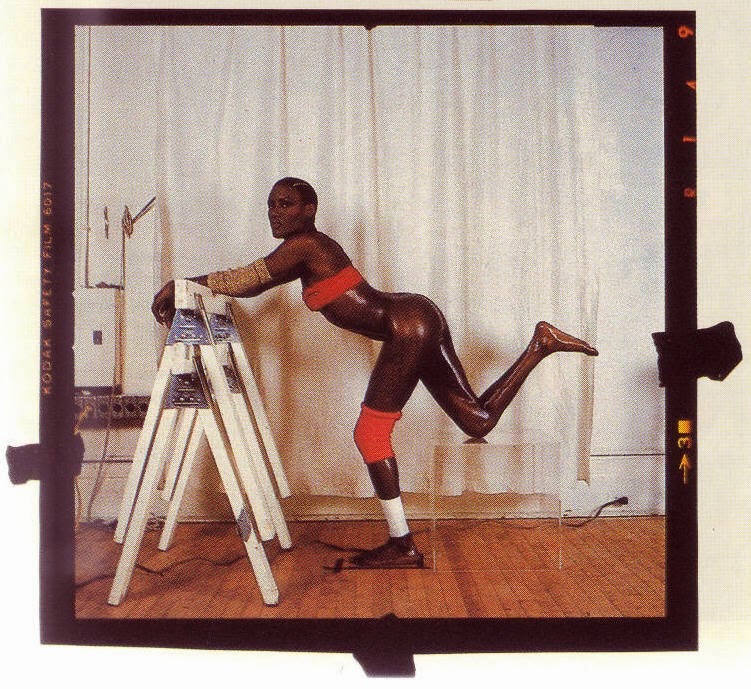
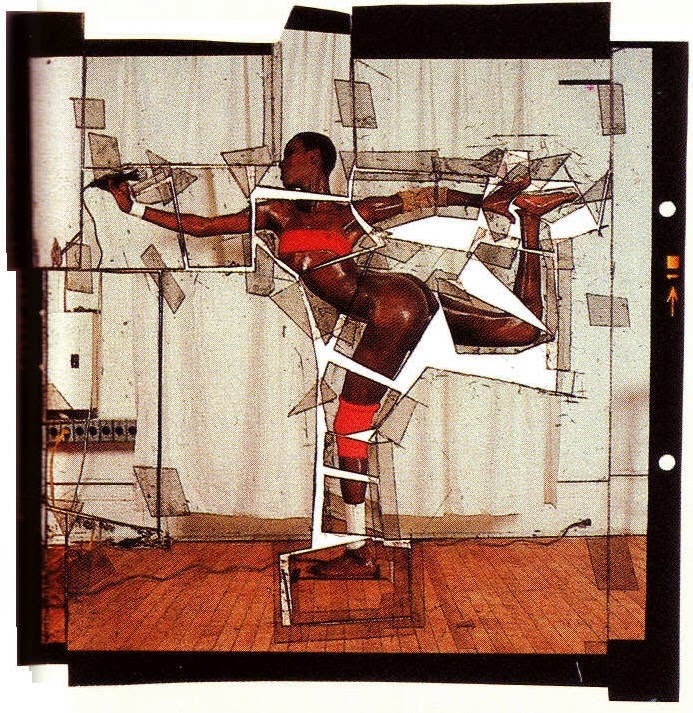
Here's something I found in a book some years ago and kept as a scan. Even before Photoshop was available it was possible to enhance the appearance of a model - although the methods were more cumbersome. I remember seeing the album Island Life - for which this was the cover picture - advertised on the London underground and marvelling at Grace Jones's physique. It seems that she wasn't quite as I'd been led to believe. (We were less aware, if not completely unaware, of what was going on back then.)
The Concept

The Reality
The Reconstruction
The Outcome
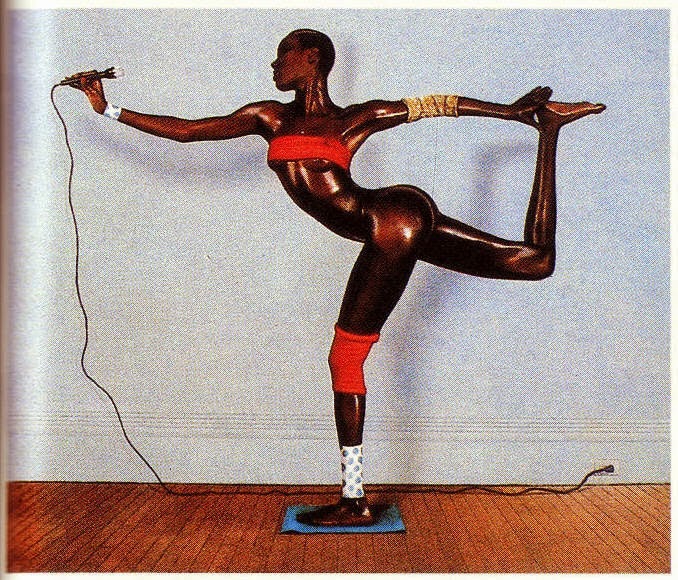
The Concept
The Reality
The Reconstruction
The Outcome
Sunday, 23 June 2013

Wednesday, 29 May 2013
After summer is gone ...
It should be summer in the UK. Some days it feels as if it is; some days it doesn't. Autumn and winter are always certainties; they come every year without fail. One autumn I found this in the garden. Fascinated by the delicate skeleton within the leaf, I kept it.


Sunday, 5 May 2013
Worse than eating horsemeat
It seems that the British horsemeat scandal has largely blown over. Things could have been worse though. Look at the homecooked food this pub is offering!


Thursday, 17 January 2013
A Dice
The word dice is a plural word. People often mistakenly use the word dice to refer to a single die. Hence the expression 'the die has been cast' (a phrase with an interesting history) and not 'the dice ...'. However, I came across this interesting object in Vienna in November 2005 (although it seems to have been made in China). Here we have a die-within-a-die. So, in a sense, there is something singular about it. So might this be 'a' dice?


NB On both dice, the one and the four are represented by red spots, whereas all the other numbers are represented by black spots. I afraid don't know why.
Friday, 13 July 2012
Found while tidying my iPod
Some thoughts (which may or may not mean anything) from a variety of sources:
- The child is to the adult as the philosopher is to the mind of God.
- We fit ourselves to the hours of the day. Instead, we should fit the hours of the day to ourselves.
- One needs time for those happy accidents (and inspirations) to occur.
- "The idea of the uncompromising thinker who follows his [own] genius caring nothing for the approval of the world seems, perhaps, just a romantic fantasy. But is it just possible that the new idealist of our own age is out there perfecting a comprehensive system raging in the dark? Maybe it is you. Maybe you're out there my doppelgänger. Take your time". (Transcribed from the Radio 4 programme 'The Romantic Road'.)
- "A snail is God's word in the shape of a shell." (Gregory Normington on Radio 3's 'The Verb'.)
- "Blessed be the inquisitive of the Lord." (Gregory Normington on Radio 3's 'The Verb'.)
- HBK FiNN has a CD entitled 'Light in the Shade of Darkness'. (This struck me as an interesting title. What is also interesting is the way in which he often uses capital letters, except when it comes to the letter 'i'. So it's 'LiGHT iN THE SHADE OF DARKNESS'.)
- Dyslexia as social and existential alienation. (I'm dyslexic and I don't know what this might mean. I include it because it is intriguing.)
Monday, 17 October 2011
Slippers
This picture, of some rather dainty slippers that some child must have awoken that Sunday morning to find missing, was taken at the westbound bus stop in Altenberg on the same day (1st May 2005) that I took the picture of 'Danude' Fish - about which I blogged in August. The previous evening there had been a street party in Donaustraße to celebrate May day.

Subscribe to:
Posts (Atom)